
Phuket Property Market Outlook 2026: Trends, Pricing & Investment Dynamics
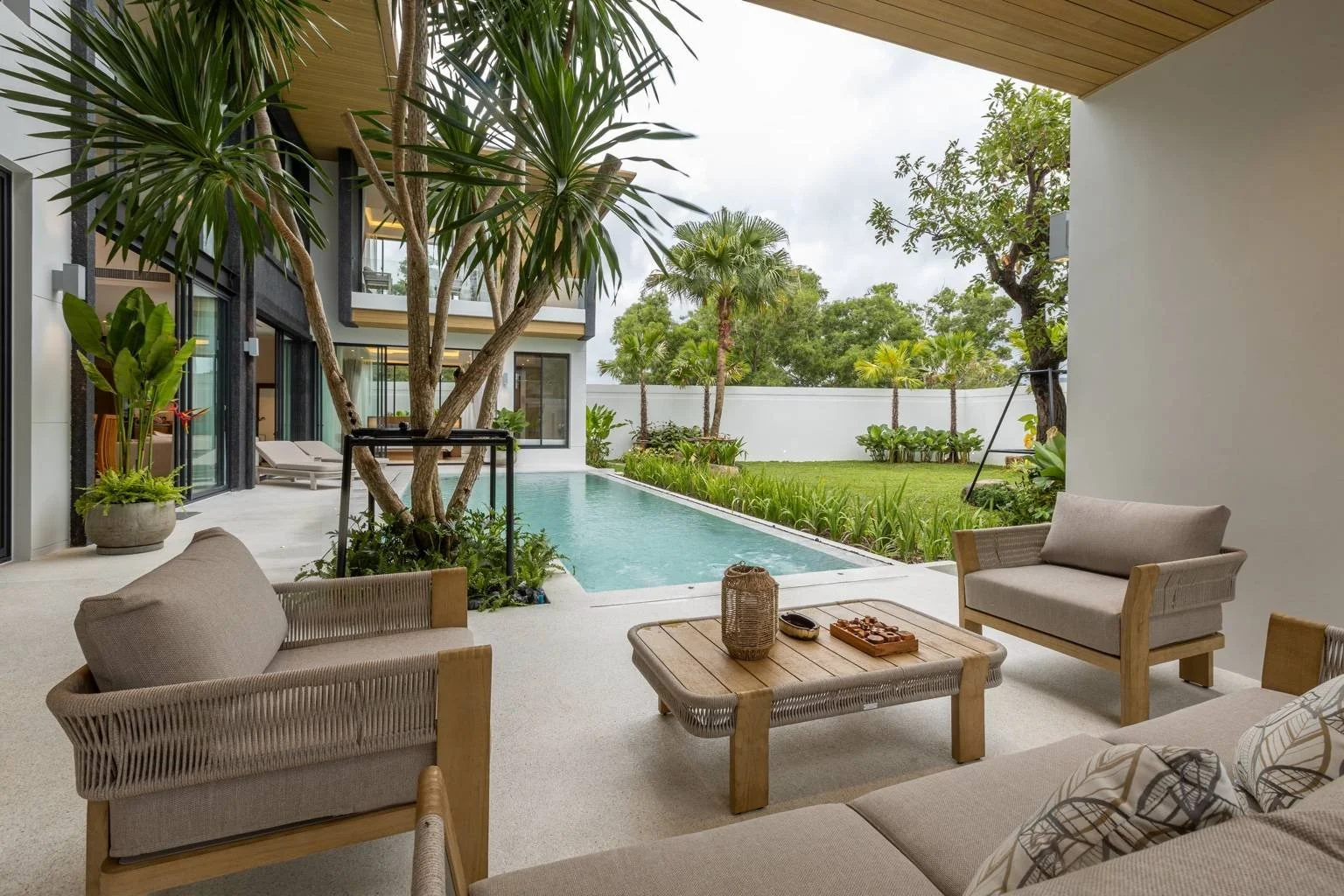
Phuket remains one of Thailand’s most important property markets for foreign buyers in 2026. The island combines a tourism-led short-stay economy with a growing base of long-stay residents, international families and lifestyle relocators. Unlike purely seasonal resort destinations, Phuket now functions as a hybrid market, supporting both investment-driven and lifestyle-led ownership.
This outlook examines how Phuket’s property market is evolving going into 2026, including pricing trends, buyer behaviour, rental performance, supply dynamics and the structural factors shaping long-term value. It is designed as a practical reference point for investors and buyers comparing Phuket with Bangkok and other regional markets.
Phuket Property Market 2026 — Key Facts
- Phuket combines short-term rental demand with growing long-stay residency, supporting both yield-driven and lifestyle-led ownership.
- Short-term rental yields typically range from 8–15% per year, while long-term rentals often deliver around 6–8% annually.
- Pricing varies significantly by location, elevation and branding, rather than following uniform island-wide averages.
- Condominium and villa markets behave differently, with distinct ownership structures, supply dynamics and rental profiles.
- Land availability and zoning constraints limit future supply in many of Phuket’s most desirable residential areas.
- Infrastructure investment and tourism recovery continue to underpin demand heading into 2026.
Market Fundamentals: What Underpins Demand
Tourism as the Core Demand Engine
Tourism remains the primary driver of Phuket’s property market. International arrivals have continued to recover strongly following the pandemic, with flight capacity and visitor volumes now approaching and in peak periods exceeding pre-2020 levels. Phuket International Airport has steadily expanded its international route network, supporting demand from Europe, Australia, the Middle East and across Asia.
Crucially, Phuket’s tourism demand is diversified rather than dependent on a single source market. This breadth helps stabilise occupancy across economic cycles and supports the island’s reputation as one of Southeast Asia’s most resilient resort markets. For property investors, this translates into more consistent rental demand compared with destinations that rely heavily on a narrow seasonal visitor base.
A Maturing Long-Stay Profile
Alongside tourism, Phuket has seen sustained growth in longer-stay residents. Digital nomads, retirees, remote professionals and relocating families now form a meaningful share of the demand base. International schools, private healthcare facilities and lifestyle infrastructure have expanded steadily, particularly in Bang Tao, Cherng Talay, Layan and parts of Kamala and Rawai.
This combination of short-stay and long-stay demand is central to Phuket’s investment appeal. It allows many developments to operate across multiple rental strategies, reducing reliance on peak tourism seasons alone and supporting more stable year-round occupancy.
How Phuket Differs from Bangkok
While both Phuket and Bangkok are driven by location and infrastructure, the mechanisms are different. Bangkok’s pricing and rental dynamics are shaped primarily by transport connectivity, employment hubs and long-stay tenant demand. Phuket, by contrast, is influenced more heavily by elevation, view orientation, proximity to lifestyle infrastructure and access to beaches or resort zones.
As a result, pricing dispersion within Phuket is wider, and two properties a short distance apart can perform very differently depending on outlook, management quality and target rental segment. This makes micro-location and project selection particularly important for buyers.
Supply Overview: Condominiums vs Villas
Phuket’s residential supply is best understood as two distinct markets: condominiums and villas. While both serve international buyers, they operate under different planning rules, ownership structures and absorption dynamics.
Condominium Supply
New condominium supply in Phuket is concentrated in defined development corridors rather than spread evenly across the island. Areas such as Bang Tao, Cherng Talay, Kamala and Patong account for the majority of new internationally marketed projects, particularly those designed to accommodate foreign ownership and managed rental use.
Developers increasingly focus on projects with professional management, rental infrastructure and hotel-style services. This reflects buyer demand for hands-off ownership and income generation rather than purely residential use. As a result, new supply tends to be clustered in master-planned zones where rental demand, infrastructure and accessibility are already established.
Condominium delivery remains measured rather than speculative. Projects are typically phased, and foreign freehold quotas are actively managed to maintain pricing stability and absorption momentum.
Villa Supply
Villa development follows a very different pattern. Supply is constrained by land availability, zoning regulations, infrastructure capacity and environmental controls, particularly in west-coast and hillside locations. Unlike condominiums, villas cannot be scaled vertically, and suitable land parcels are increasingly scarce.
This has two important effects. First, villa supply grows more slowly and predictably. Second, pricing tends to be more resistant to downturns, as replacement supply is limited and land values underpin long-term pricing. This dynamic is especially evident in Bang Tao, Layan, Cherng Talay and Kamala, where established villa enclaves have matured over time.
Pricing Trends in Phuket Going Into 2026
Property pricing in Phuket continues to vary primarily by location, asset type and positioning rather than following a single island-wide benchmark. Condominiums and villas operate in distinct price brackets, and within each category, factors such as elevation, view profile, branding and management structure play a meaningful role in price differentiation.
Across established lifestyle hubs and tourism-led districts, entry pricing remains accessible relative to many global resort markets, while premium stock commands higher values where land availability and replacement supply are constrained.
Indicative Phuket Property Pricing (2026)
| Location Type | Asset Type | Typical Entry Pricing (THB) |
|---|---|---|
| Bang Tao / Cherng Talay | Condominium | Approximately THB 5–7 million |
| Layan | Condominium | Approximately THB 7–9 million |
| Patong (hillside) | Condominium | Approximately THB 9–12 million |
| Island-wide | Villa (entry level) | Approximately THB 12–18 million |
| Cherng Talay / Bang Tao | Villa | Approximately THB 25–35 million |
| Established coastal & hillside zones | Villa (upper tier) | THB 35 million and above |
These ranges reflect typical entry-level pricing observed across internationally marketed developments in Phuket. Larger layouts, sea views, higher floors and branded management structures generally sit above these starting points.
Leasehold and Freehold Pricing Considerations
In condominium projects, advertised starting prices are often based on leasehold ownership, particularly where foreign freehold quotas are limited or already partially allocated. Freehold units typically command a premium once availability becomes constrained. Buyers comparing pricing should therefore account for ownership structure when assessing overall value and budget requirements.
Rental Performance & Yield Expectations
Rental performance remains one of Phuket’s defining investment characteristics. The island benefits from a dual demand base: strong short-stay tourism alongside a growing population of long-stay residents, digital professionals and relocating families. This combination supports both short-term and long-term rental strategies, depending on asset type and location.
While developers may publish optimistic projections, a more useful approach for planning is to distinguish between headline potential and conservative expectations based on market history and operating realities.
Indicative Rental Yield Ranges (2026)
| Asset Type | Rental Strategy | Indicative Yield Range | Key Considerations |
|---|---|---|---|
| Condominium | Short-term rental | 8–15% (gross) | Highest in managed, tourism-led projects |
| Condominium | Long-term rental | 6–8% | More stable, lower operational intensity |
| Villa | Holiday rental | 5–8% | Performance varies by management and seasonality |
Short-term rentals typically deliver the strongest headline yields, particularly in professionally managed condominiums located close to beaches, dining and transport links. However, these returns are more sensitive to seasonality, pricing discipline and operating costs.
Long-term rentals offer lower but steadier income, appealing to buyers prioritising predictability over peak returns. Villas, while attractive for lifestyle use and long-term capital value, tend to deliver more moderate yields once maintenance, staffing and vacancy periods are accounted for.
Readers seeking a deeper breakdown can refer to our Phuket rental yields guide, which explores performance by area and asset type in more detail.
Buyer Profiles & Investment Strategies
Yield-focused investors typically favour smaller condominium units in high-occupancy locations, particularly within professionally managed or branded developments. These buyers prioritise rental liquidity, operational efficiency and consistent demand rather than long personal use.
Lifestyle-led buyers gravitate toward villas or dual-use condominiums that support personal stays alongside rental income. For this group, privacy, space and location quality often carry as much weight as yield, with holding periods tending to be longer and usage more flexible.
Diversification buyers increasingly hold assets in both Phuket and Bangkok. This approach balances Phuket’s tourism-driven income potential with Bangkok’s long-stay rental stability and deeper urban tenant base, creating a more resilient regional property portfolio.
Foreign ownership structures play a central role in shaping acquisition strategy. Freehold condominium quotas, leasehold terms and renewal frameworks influence pricing, availability and long-term planning. Buyers unfamiliar with these structures may benefit from reviewing our Thailand foreign ownership guide and villa leasehold explainer before committing to a specific asset type.

Phuket’s Key Property Locations in 2026
Phuket’s property market is organised around distinct lifestyle and investment nodes rather than a single urban core. Buyer demand in 2026 remains concentrated in a handful of west-coast and near-west clusters where beaches, infrastructure and rental liquidity intersect. Understanding how these areas differ is essential when comparing pricing, yield potential and long-term resilience.
Bang Tao & Cherng Talay
Bang Tao and Cherng Talay form Phuket’s most established lifestyle-led residential hub. Proximity to the beach, international schools, dining, retail and resort infrastructure has supported consistent demand from both long-stay residents and short-term renters. The area appeals to buyers seeking modern condominiums with managed rental capability as well as low-density villa estates designed for dual personal use and income.
Development in this zone has increasingly focused on master-planned projects rather than ad hoc builds, helping maintain quality control and rental performance. Managed condominium projects such as The Zero Bang Tao and Siamese Bang Tao illustrate the area’s emphasis on accessibility, amenities and year-round occupancy, while surrounding villa estates attract buyers prioritising space and privacy over pure yield.
Layan
Layan sits at the upper end of Phuket’s residential spectrum, characterised by lower density, hillside positioning and proximity to premium beach frontage. Buyer demand here skews towards lifestyle and capital preservation rather than short-term yield optimisation. Projects tend to emphasise views, privacy and architectural quality, with pricing reflecting scarcity rather than rental metrics alone.
Developments such as Ayana Heights reflect Layan’s positioning as a long-term residential enclave rather than a high-turnover rental zone. While rental demand exists, particularly in peak seasons, Layan is more commonly chosen by buyers with longer hold horizons and personal usage plans.
Patong (Hillside Zone)
Patong remains Phuket’s strongest short-stay rental market, driven by year-round tourism depth rather than seasonal peaks alone. While beachfront and central Patong are highly commercial, hillside developments have emerged as a distinct sub-market offering elevation, views and quieter settings without sacrificing rental demand.
Investor interest in Patong’s hillside zone has grown as land availability has tightened and professionally managed projects have become more selective. Developments such as ABOV Patong demonstrate how branded management and hillside positioning can coexist with Patong’s exceptional occupancy profile, making the area particularly attractive to yield-focused buyers who still want asset differentiation.
Kamala
Kamala occupies a middle ground between lifestyle and investment. The area benefits from a calmer environment than Patong while still supporting holiday rental demand, particularly in managed villas and serviced residences. Kamala’s appeal lies in its balance: quieter than Bang Tao’s commercial spine, but more rental-oriented than Layan.
Buyer profiles here are mixed, ranging from holiday-home owners to investors seeking mid-range pricing with steady, if less aggressive, rental performance. Supply remains relatively controlled due to geography and zoning, helping support pricing stability.
Rawai & Nai Harn
At the southern end of the island, Rawai and Nai Harn attract longer-stay residents, retirees and families rather than short-term tourists. Demand is driven by lifestyle factors such as beach access, dining, marina facilities and a more established expat community.
Rental yields here are typically lower than west-coast tourism hubs, but holding costs are often offset by longer tenancy durations and reduced volatility. These areas suit buyers prioritising liveability over short-term income optimisation.
Capital Growth and Long-Term Outlook
Capital growth in Phuket has historically been driven less by rapid price inflation and more by structural constraints on supply combined with sustained international demand. Unlike urban markets that expand vertically or through transport-led densification, Phuket’s geography, zoning regulations and environmental controls impose natural limits on development, particularly in coastal and hillside locations.
For condominiums, long-term value performance is closely linked to location quality, project differentiation and operational maturity. Developments in established lifestyle hubs with access to beaches, amenities and professional management tend to show greater price stability once completed, particularly after rental performance becomes established. Branded or professionally managed projects often benefit from stronger resale liquidity as buyers place increasing value on operational track records rather than conceptual positioning.
Villas follow a different capital growth profile. Because they are underpinned by long-term land rights and the scarcity of developable land, pricing is more directly influenced by land availability and replacement cost. In mature villa zones where available plots are limited, capital values tend to be more resistant to broader market fluctuations. While short-term price movements can be uneven, long-term holders often benefit from the inability to replicate similar assets at scale.
Holding period plays an important role in realised capital performance. Buyers with shorter horizons may see outcomes influenced by market cycles and timing, whereas longer-term owners are more likely to benefit from Phuket’s gradual transition toward a mature international residential market. As infrastructure, services and buyer expectations continue to evolve, well-located assets typically shift from speculative pricing toward use-value and income-supported valuation, reinforcing long-term resilience.
Overall, Phuket’s capital growth outlook into and beyond 2026 is best viewed as steady rather than accelerated, with the strongest outcomes concentrated in supply-constrained locations and assets that combine location quality with operational credibility.
Future Catalysts Influencing Phuket’s Property Market
Phuket’s medium-term property outlook is shaped less by cyclical market sentiment and more by structural developments that affect accessibility, liveability and long-stay demand. Several identifiable catalysts are likely to influence buyer behaviour and asset performance going into 2026 and beyond.
Phuket International Airport Expansion
Phuket International Airport remains one of Thailand’s busiest gateways outside Bangkok and operates under sustained capacity pressure during peak travel periods. Expansion plans have been widely discussed for several years, with phased improvements aimed at increasing passenger handling capacity and easing congestion rather than transforming Phuket into a mass-transit hub.
For the property market, the significance lies in reliability and resilience rather than volume growth alone. Improved airport capacity supports year-round tourism, reduces seasonal bottlenecks and makes longer-stay travel more practical, particularly for families, retirees and repeat visitors. These dynamics tend to reinforce demand for well-located residential assets rather than drive speculative development.
Infrastructure and Planning Maturity
Infrastructure investment in Phuket has largely focused on phased improvements to transport, utilities and planning controls rather than large-scale urban transformation. Road improvements, utilities upgrades and more consistent enforcement of planning controls have contributed to a gradual tightening of development standards, particularly in coastal and hillside zones.
As planning controls are applied more consistently, new development is increasingly concentrated in established zones rather than expanding indiscriminately into undeveloped areas. This limits the volume of new supply entering the market at any one time and reinforces the value of locations where infrastructure, access and services are already in place.
Long-Stay and Mobility Trends
Thailand’s continued focus on long-stay visa pathways, remote professionals and retirement-linked residency reflects a broader shift toward attracting higher-value, longer-duration visitors. While property ownership is not linked to residency, these policies indirectly support demand for furnished, professionally managed accommodation suitable for extended stays.
Phuket has been a key beneficiary of this trend due to its healthcare access, international schools and lifestyle appeal. As remote work and regional mobility remain structurally embedded, demand for medium- to long-term rental accommodation is likely to remain supportive across established residential zones.
Services, Education and Healthcare
Growth in international schools, private healthcare facilities and lifestyle infrastructure has reinforced Phuket’s position as more than a seasonal resort destination. These services underpin year-round occupancy and support buyer segments beyond traditional holiday use, including families relocating on a semi-permanent basis.
Over time, this broadening of demand tends to stabilise rental performance and reduce reliance on peak tourism cycles alone.
Market Risks and Mitigants
Like any internationally exposed property market, Phuket carries a distinct set of risks alongside its long-term attractions. Understanding how these risks present, and how they are commonly mitigated, is essential for informed decision-making.
Tourism Exposure
Phuket’s rental market is closely linked to tourism activity, particularly in short-stay segments. External shocks such as global travel disruptions, economic slowdowns or changes in airline capacity can temporarily affect occupancy and rental income, especially for assets reliant on peak-season demand.
Mitigant: Phuket’s tourism base is broad and diversified, spanning leisure, long-stay visitors, regional travel and repeat international arrivals. Properties in established locations with year-round demand, and those supported by professional management, tend to recover more quickly following periods of disruption.
Regulatory and Policy Environment
Foreign ownership rules in Thailand are well established, but periodic policy discussions around land use, leasehold structures and tourism regulation can create uncertainty for buyers unfamiliar with the market. Changes are typically incremental rather than abrupt, but headlines can affect sentiment.
Mitigant: Thailand’s core condominium ownership framework has remained stable for decades, and long-term leasehold structures are widely used and legally recognised. Buyers who work within established ownership models and focus on compliant developments reduce exposure to regulatory risk.
Supply and Overdevelopment Risk
Supply risk in Phuket is not island-wide, but can occur in specific micro-locations where multiple similar projects are delivered into the market at the same time. In these instances, generic developments with limited differentiation may face short-term pressure on pricing and rental performance, particularly during initial stabilisation periods.
Mitigant: This risk is uneven across the island. Areas with constrained land availability, tighter planning controls and established demand tend to absorb new supply more consistently. In practice, asset quality, precise location and the presence of professional management have a greater influence on long-term performance than overall island-level supply volumes.
Currency Exposure
Foreign buyers are exposed to currency movements when purchasing and repatriating funds. Exchange rate fluctuations can influence both entry costs and realised returns when measured in a buyer’s home currency.
Mitigant: Many buyers view Phuket property as a long-term hold or lifestyle asset rather than a short-term currency trade. Rental income is generated and used primarily in local currency, naturally offsetting local operating costs. Surplus income can then be repatriated periodically, allowing owners to manage currency exposure over time rather than being exposed to single-point exchange rate movements.
Operational Risk
Rental performance depends not only on location, but also on execution. Poor management, inconsistent maintenance or weak pricing strategy can materially affect income outcomes, particularly in short-term rental models.
Mitigant: Professionally managed developments with established operating structures tend to deliver more consistent results. Clear rental policies, transparent fee structures and aligned incentives between owners and operators reduce operational friction.
Overall Risk Profile
Phuket’s risks are primarily tied to asset selection and execution rather than unpredictable market instability. Buyers who focus on established locations, compliant ownership structures and appropriate holding periods are generally managing known variables rather than exposing themselves to speculative uncertainty.
Conclusion
Phuket enters 2026 as a mature hybrid property market, combining tourism-driven rental demand with a growing base of long-stay residents and structurally constrained supply in its most established locations. These characteristics continue to underpin interest from international buyers seeking both income potential and lifestyle flexibility.
Outcomes in Phuket are shaped less by market timing and more by asset selection. Buyers who understand the differences between sub-markets, ownership structures and rental models are better positioned to align expectations with long-term performance.
For readers looking to explore current Phuket developments in more detail, see our Phuket property listings.
FAQ: Phuket Property Market 2026
-
Phuket remains one of Thailand’s most established property markets for foreign buyers. Demand is supported by a combination of international tourism, repeat long-stay visitors and a growing base of semi-permanent residents. Performance, however, varies significantly by location and asset type rather than moving uniformly across the island.
-
Condominiums and villas suit different objectives. Condominiums generally offer higher rental liquidity and simpler ownership structures for foreign buyers, particularly in professionally managed developments. Villas tend to suit lifestyle-led buyers and longer holding periods, with value more closely linked to land scarcity and location quality than short-term income.
-
Rental yields in Phuket vary by strategy and asset type. Short-term rentals typically deliver gross yields in the region of 8–15% per year, particularly in managed developments located near beaches and amenities. Long-term rentals more commonly fall in the 6–8% range, offering greater income stability with lower operational intensity. Actual outcomes depend on location, management quality, seasonality and pricing discipline, and buyers should plan conservatively rather than rely on headline projections.
-
Thailand’s condominium ownership framework for foreigners has been in place for decades and is well established. Villas are typically held through building ownership combined with registered long-term land leases. Buyers who operate within these recognised structures and conduct proper legal due diligence are working within a stable and widely used framework.
-
Oversupply risk in Phuket is not island-wide, but can occur in specific micro-locations where multiple similar projects are delivered at the same time. In these areas, undifferentiated developments may face short-term pressure on pricing or rentals. By contrast, locations with constrained land availability, established infrastructure and consistent demand tend to absorb new supply more effectively.
-
Location is one of the most important determinants of long-term performance. Established sub-markets with proven demand, limited land availability and access to infrastructure tend to show greater resilience. Within any area, micro-factors such as elevation, view profile and proximity to amenities often matter more than the district name alone.
-
Risk in Phuket is primarily tied to asset selection and execution, rather than unpredictable market instability. Buyers who prioritise established locations, compliant ownership structures, appropriate management and realistic holding periods are generally managing known variables rather than speculative risk.
